Building an SME Growth Roadmap: From Survival to Scale
For many small and medium-sized enterprises (SMEs), growth is the ultimate goal. However, growth without a strong foundation can create new problems rather than solve existing ones.
A business in survival mode needs a very different strategy from a business that is ready to scale. One of the most common mistakes SMEs make is trying to stabilise operations, improve systems, and expand into new markets all at once.
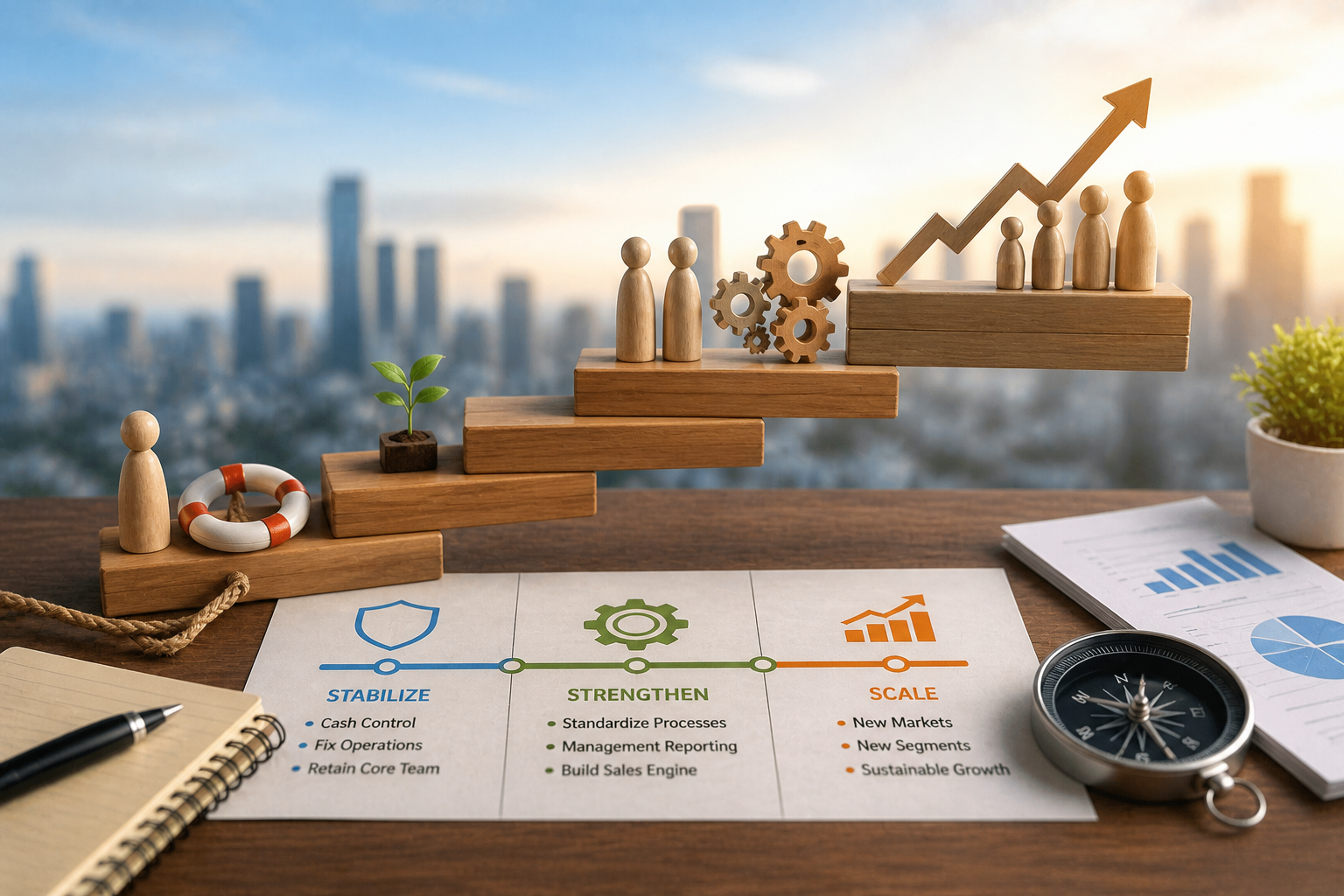
A more sustainable approach is to move through three clearly defined stages: Stabilize, Strengthen, and Scale.
Why the Right Sequence Matters
An SME that is still struggling with cash flow, operational inefficiencies, or staff retention may not be ready for rapid expansion.
Scaling too early increases complexity. New markets require additional people, systems, working capital, management capacity, and governance. If the existing business is not stable, these additional demands can quickly push it back into crisis.
The objective, therefore, is not simply to grow faster. It is to build the capability to grow sustainably.
Phase 1: Stabilize — 0 to 6 Months
The first priority is survival and control.
During this stage, management should focus on protecting cash, retaining essential employees, and fixing the operational issues that pose the greatest immediate risk.
Key priorities include:
- Strengthening cash-flow management
- Controlling unnecessary expenditure
- Protecting key customers and revenue
- Retaining critical employees
- Resolving urgent operational bottlenecks
- Establishing basic financial visibility
At this stage, expansion should generally take a back seat. The key question is:
“How do we make the business stable enough to move forward?”
Key KPIs
Cash-focused indicators should dominate this phase, including cash runway, working capital, collections, liquidity, and short-term profitability.
Phase 2: Strengthen — 6 to 18 Months
Once the business is stable, attention can shift from survival to building a repeatable operating model.
The Strengthen phase is about reducing dependence on individual people and informal processes. The business should begin developing systems that allow it to operate consistently as it grows.
Key priorities include:
- Standardising core processes
- Introducing reliable management reporting
- Improving operational efficiency
- Strengthening financial controls
- Building a repeatable sales process
- Developing management capability
- Clarifying roles and responsibilities
This is also the stage where governance should become more structured.
Regular management reporting, clearer decision-making authority, and appropriate board or advisory structures can help ensure that growth does not outpace management capability.
Key KPIs
The focus shifts toward efficiency and operational performance, such as productivity, margins, conversion rates, customer retention, process efficiency, and sales pipeline performance.
Phase 3: Scale — 18 to 36 Months
Scaling should begin only when the underlying business model is sufficiently stable, repeatable, and well governed.
At this stage, the SME can consider opportunities such as:
- Entering new geographic markets
- Targeting new customer segments
- Expanding product or service offerings
- Increasing production capacity
- Building strategic partnerships
- Investing in technology
- Expanding the leadership team
The critical difference is that expansion now happens on top of an established foundation rather than being used as a solution to underlying business problems.
Key KPIs
Growth metrics become increasingly important, including revenue growth, market share, customer acquisition, geographic expansion, and return on investment.
Governance Must Grow With the Business
Growth is not sustainable if governance remains at the level of a small, informal business.
As the SME moves through each phase, governance should mature alongside it.
This can include:
Stabilize: Basic financial controls and regular cash reporting.
Strengthen: Formal management reporting, defined responsibilities, and clearer delegation of authority.
Scale: More sophisticated board oversight, strategic reporting, risk management, and performance governance.
The principle is simple: governance should develop before complexity arrives, not after it becomes a problem.
A Practical Example
Consider an SME that attempts to enter three new markets only four months after experiencing serious cash-flow and operational problems.
The expansion may initially appear attractive, but the additional complexity creates new costs, management pressure, and working-capital requirements. Instead of solving the underlying problems, the business finds itself in a larger and more expensive crisis.
Now consider a different approach.
The business spends its first six months stabilising cash flow and operations. Over the following twelve months, it standardises processes, strengthens reporting, and develops a repeatable sales engine. Once these foundations are working effectively, the business begins expanding into carefully selected markets.
The opportunity may be similar in both cases, but the outcomes can be dramatically different.
The SME Growth Roadmap
A sustainable growth journey can therefore be visualised as:
0–6 Months → Stabilize
Cash discipline, operational control, team retention
6–18 Months → Strengthen
Systems, processes, reporting, efficiency, repeatable sales
18–36 Months → Scale
New markets, new segments, capacity expansion, strategic growth
The exact timing will vary between businesses, but the underlying principle remains consistent: do not scale complexity faster than the organisation can manage it.
Conclusion
For SMEs, sustainable growth is less about moving as quickly as possible and more about moving in the right sequence.
Stabilize first. Strengthen the foundation. Then scale.
When cash discipline, operational systems, management capability, and governance mature before expansion begins, growth becomes more controlled, measurable, and resilient.
The strongest SME growth strategies do not treat survival and scale as competing priorities. Instead, they recognise that survival creates stability, stability enables strength, and strength creates the foundation for sustainable scale.